
Traditional security tools look for crashes, error codes, and known attack patterns. They scan for what's broken on the surface. AI thinks differently. It reads code the way a developer would — understanding the intent behind the logic, spotting contradictions between what the software is supposed to do and what it actually does under certain conditions. That's how it found a flaw that everything else had missed.
For years, two-factor authentication — the extra verification step that sends a code to your phone or app when you log in — has been one of the most reliable defenses against unauthorized account access. Most businesses have adopted it as a standard security practice. For good reason.
But a landmark report published on May 11, 2026 by Google's Threat Intelligence Group just changed the conversation — and every business that relies on two-factor authentication needs to understand what happened.
What Happened
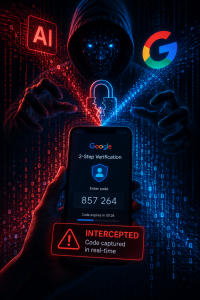
For the first time ever, Google confirmed a real-world case of cybercriminals using artificial intelligence to build a working exploit that bypasses two-factor authentication. This is not a theoretical risk or a proof-of-concept in a research lab. This was a criminal group, actively planning a mass exploitation campaign, using AI to do something that previously would have taken highly skilled human hackers significantly more time to accomplish.
The attackers used an AI model to identify a logic flaw inside a widely used open-source web administration tool — a flaw that traditional security scanners had missed entirely. The AI didn't just find the vulnerability. It built a working exploit around it. A Python script, ready to deploy, designed specifically to slip past two-factor authentication protections. Google worked with the affected vendor to patch the flaw and disrupt the campaign before it launched — but the warning is clear.
Why This Is a Turning Point
What makes this discovery so significant is not just what happened — it's what it tells us about where cyberattacks are heading.
Google noted that state-sponsored hacking groups linked to China and North Korea are also actively using AI for vulnerability research and exploit development. This is no longer an emerging threat. It is the current threat.
Why This Matters for Small Businesses
Large enterprises have dedicated security teams monitoring for exactly this kind of activity. Small and mid-sized businesses typically don't. That gap — between the speed at which AI-assisted attacks can now be developed and the resources most small businesses have to defend against them — is exactly where criminals look for opportunity.
Two-factor authentication is still one of the most effective security measures available. But this report is a clear signal that relying on it alone, without layering in other protections and staying current on updates, is no longer enough.
Where Businesses Are Most Exposed
- Outdated software and unpatched systems — The exploit in this case targeted a known tool that had an undiscovered logic flaw. Keeping all software and admin tools updated is the first line of defense.
- SMS-based two-factor authentication — Text message codes are the weakest form of 2FA. They can be intercepted through SIM-swapping attacks and are more vulnerable than app-based alternatives.
- Overconfidence in a single security layer — Two-factor authentication is a critical tool, but it is one layer — not a complete defense. Businesses that treat it as their only protection are exposed.
- Lack of monitoring after login — AI-assisted exploits are designed to look normal. Without monitoring for unusual activity after authentication, a successful bypass can go undetected for a long time.
What Your Team Should Do Right Now
- Keep all software, admin tools, and web-based platforms fully updated — patches exist specifically to close the logic flaws that AI can now find and exploit.
- Upgrade from SMS-based two-factor authentication to an authenticator app wherever possible. Apps like Microsoft Authenticator or Google Authenticator are significantly more secure than text message codes.
- For your most sensitive accounts and systems, consider hardware security keys — the strongest form of two-factor authentication available.
- Layer your security. Two-factor authentication should work alongside strong passwords, access controls, and activity monitoring — not replace them.
- Educate your team that even a prompt that looks like a legitimate login request could be part of an AI-assisted attack. When in doubt, verify through a separate channel before taking action.
- Work with your IT provider to audit which tools and platforms your business relies on, and ensure none of them are running outdated or unpatched versions.
The Bottom Line
AI has fundamentally changed the speed and sophistication at which cyberattacks can be developed. A flaw that would have taken a skilled human hacker weeks to find and weaponize can now be identified and exploited in a fraction of the time. Two-factor authentication is still worth having — but this report is a clear reminder that no single security measure is a complete solution. Layered defenses, updated software, and a team that knows what to watch for are what keep businesses protected in 2026 and beyond.
Have questions about your current security setup or how to strengthen your defenses against AI-assisted attacks? Reach out to us — we're here to help.